
Why AI needs a business ontology
Large language models are powerful, but without structured domain context they guess from column names and hope for the best. A business ontology gives any AI system — analytics engines, customer support agents, coding assistants, ops automation — the definitions, relationships, synonyms, and mappings it needs to operate accurately. Magnus, Magnowlia's AI ontology agent, builds the ontology for you — your role is to review that he understood your domain correctly.
The problem with column-name guessing
When you point an LLM at a database schema and ask “show me revenue by region,” it scans the column names looking for something that resembles revenue. If the column is called total_amount, it might work. If it is called amt_net_usd or gmv_excl_tax, the model guesses, and guesses are often wrong.
The problem compounds with joins. The LLM does not know that Orders connect to Customers through orders.customer_id = customers.id unless it infers it from naming conventions. If the schema uses cust_fk instead, the inference fails.
The result is plausible-looking SQL that uses the wrong columns, the wrong joins, or the wrong aggregation. Users get an answer that looks right but is subtly incorrect, and they have no way to verify it without manually inspecting the generated query.
How an ontology provides AI context
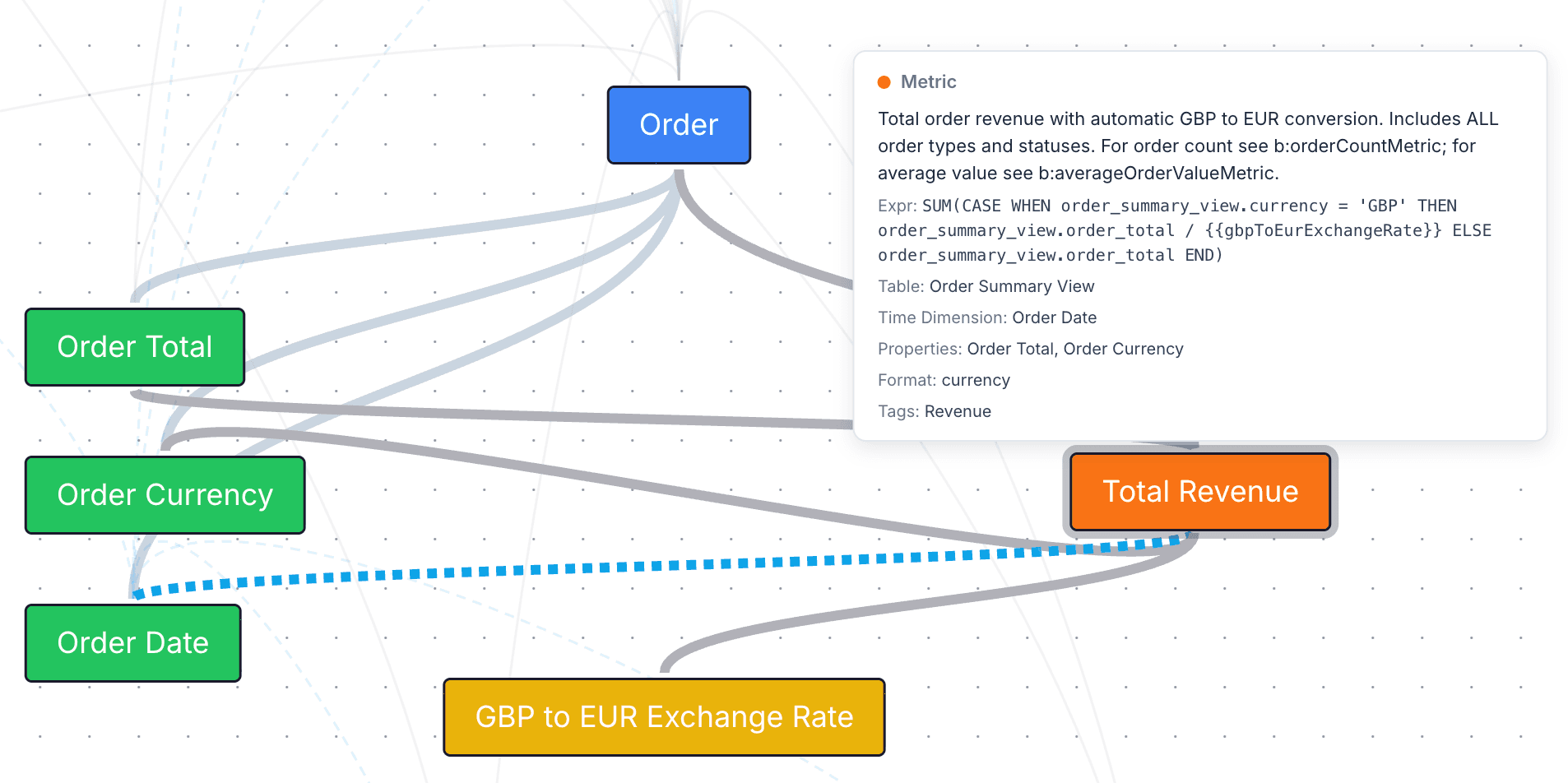
An ontology replaces guesswork with explicit declarations. Instead of scanning column names, the AI reads a formal model that tells it exactly what each concept means, how concepts relate, and where data lives.
Formal definitions
Each metric has a precise SQL expression, a time dimension, and a source entity. The AI does not need to figure out how to calculate revenue; the ontology tells it.
Typed relationships
Relationships between concepts (Customer places Order, Order contains LineItem) are declared with join conditions. The AI knows exactly how to join tables without guessing. Metric correlations go further — they tell the AI which metrics move together and which ones drive which, enabling smarter multi-metric analyses and anomaly detection.
Synonyms and alternative labels
SKOS altLabel lets each concept have multiple names. “GMV,” “Gross Merchandise Value,” and “Revenue” can all resolve to the same metric definition.
Explicit mappings
Every business concept maps to physical tables and columns. The AI traces from the business question straight to the database schema, with no ambiguity about which column to use.
How Magnowlia uses the ontology for AI queries
When a user asks a question in plain English, Magnowlia does not send raw column names to the LLM. Instead, the system follows a pipeline that uses the ontology at every step.
1. Resolve concepts: The question “show me revenue by region” is matched against ontology labels and altLabels. “Revenue” resolves to b:TotalRevenue; “region” resolves to the b:region dimension.
2. Read metric definition: The system reads the metric's expression, time dimension, source entity, pre-filters, and dependencies directly from the ontology.
3. Resolve joins: If the metric's source entity and the dimension's entity are different, the ontology provides the exact join condition through the relationship graph. No guessing from column names.
4. Generate SQL: The SQL is assembled from ontology-provided components: the metric expression goes into SELECT, the source entity's table into FROM, the join condition into JOIN, and the pre-filter into WHERE.
5. Explain the answer: Every result references the ontology definitions it used: which metric, which table, which filters. The user can trace the answer back to its source without reading the SQL.
Example: synonym resolution with altLabel
Different teams and stakeholders use different names for the same concept. The ontology handles this through skos:altLabel:
b:totalRevenueMetric a bv:Metric ;
    rdfs:label "Total Revenue" ;
    skos:altLabel "Revenue" , "Net Revenue" , "GMV" ;
    bv:metricExpression "SUM(b:orderTotal)" ;
    bv:timeDimension b:orderDate ;
    bv:sourceEntity b:Order ;
    bv:metricCategory "Revenue" .
When a user asks about “GMV” or “net revenue,” the system matches against the altLabels and resolves to the same canonical metric. Without this, an AI system would either fail to find the metric or create a separate, incorrect query.
This applies to every concept in the ontology: classes, properties, and relationships can all carry alternative labels. Legacy system names, abbreviations, and regional terminology all resolve correctly.
Built-in data governance for AI queries
AI-generated queries must respect the same access rules as any other data consumer. The ontology embeds governance metadata directly on properties, so the platform can enforce masking and access control automatically — without relying on the LLM to remember the rules.
b:customerEmail a owl:DatatypeProperty ;
    rdfs:label "Customer Email" ;
    rdfs:domain b:Customer ;
    rdfs:range xsd:string ;
    bv:sensitivityLevel "Restricted" ;
    bv:complianceCategory "PII" ;
    bv:maskingRule "redact" ;
    m:mapsToColumn t:public.customers.email .
bv:sensitivityLevel and bv:complianceCategory classify the field. When the AI generates a query that touches this column, the platform applies the bv:maskingRule server-side — the raw email address never reaches unauthorized users, regardless of what the LLM produces.
Beyond analytics: ontology as a shared AI knowledge layer
Magnowlia starts with analytics because that is where the pain is sharpest — teams waste hours reconciling metrics that should have been defined once. But the ontology you build is not locked to analytics. It is a machine-readable map of your business that any AI system can plug into.
Customer support agents — An AI support agent can read the ontology to understand product relationships, customer segments, and business rules. When a customer asks about their order status, the agent knows that an Order belongs to a Customer, has LineItems, and connects to a Shipment — without custom prompt engineering per use case.
Coding agents — A coding assistant working on your codebase can reference the ontology to understand your domain model: what entities exist, how they relate, what business terms mean. This makes generated code more aligned with your actual business logic.
Ops and automation agents — Workflow automation tools can use the ontology to understand which processes connect to which entities, what triggers exist, and how business events propagate through the system.
Sales assistants — An AI sales tool can read the ontology to understand product hierarchies, pricing dimensions, and customer segments — giving it the context to answer prospect questions accurately without hallucinating product details.
The ontology is stored as standard W3C OWL/Turtle. Any system that reads RDF can consume it. You define your business context once in Magnowlia; every AI agent in your stack benefits.
Explore more
What is a business ontology?
Definitions, comparisons, and a step-by-step walkthrough.
Learn more →Ontology examples
Real-world Turtle snippets for e-commerce, SaaS, and marketing.
View examples →Benefits of an ontology
Consistent metrics, traceability, governance, and faster onboarding.
Learn more →Ontology and semantic layer
Your ontology is a semantic layer — and so much more.
Learn more →Give every AI agent the context it needs
Define your business ontology once and let every AI system in your stack — from analytics to customer support to automation — operate with accurate, shared context. No credit card required.
Get Started Free